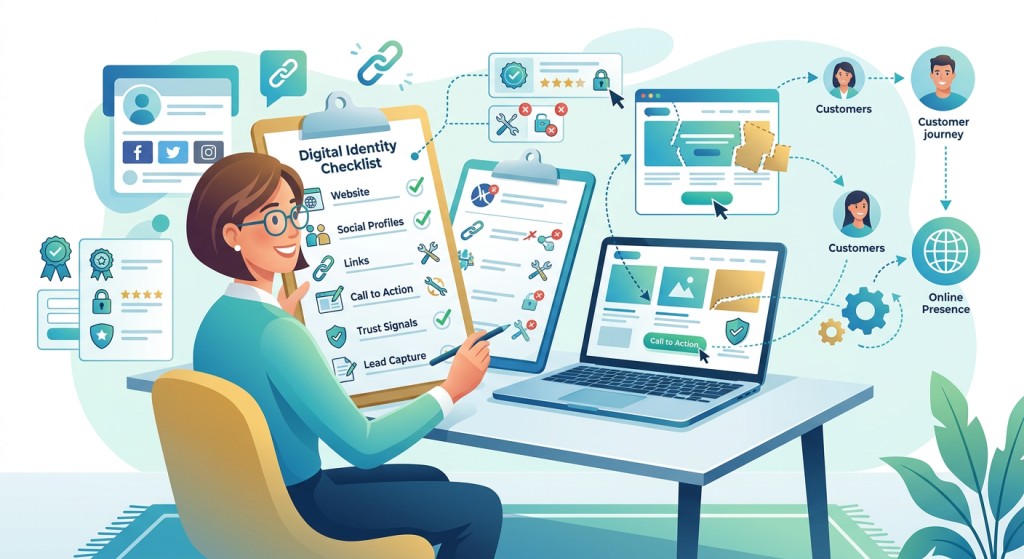
 After writing about digital identity, online presence, and the ways small businesses can leak opportunities online, I wanted to end this short series with something practical.
Because it is one thing to talk about the importance of your digital identity.
It is another thing to actually sit down and review it.
Most small business owners, freelancers, consultants, creators, and side hustlers already have a lot going on. The last thing they need is another complicated project that feels overwhelming.
So this post is meant to be simple.
Think of it as a digital identity checklist you can use to take a first look at how your online presence is working.
You do not have to fix everything in one day.
But you do need to know what is working, what is outdated, and where people may be getting confused.
Why a Checklist Helps
The internet has a way of spreading us out.
You may have a website, Facebook page, LinkedIn profile, Instagram account, YouTube channel, TikTok profile, X account, Google Business Profile, email list, landing page, booking calendar, old blog, and a few other platforms you barely remember creating.
At first, everything may have made sense.
But over time things change.
Your offer changes.
Your audience changes.
Your projects change.
Your links change.
Your goals change.
Your message changes.
The problem is that your old digital footprint does not always change with you.
That is why a checklist helps.
It gives you a simple way to slow down and look at what people are actually seeing when they find you online.
Start With the First Impression
The first thing to review is the first impression people get when they find you.
This could be your website homepage, your LinkedIn profile, your Facebook page, your Instagram bio, your YouTube channel, or even a search result.
Ask yourself:
- Does this look current?
- Does this look trustworthy?
- Is it clear who I am?
- Is it clear what I do?
- Is it clear who I help?
- Would a stranger understand why this matters?
You do not need to sound like a giant company.
In fact, for many personal brands and small businesses, being human and approachable is a strength.
But people should not have to work hard to understand you.
Review Your Main Message
Your message is one of the most important parts of your digital identity.
If your message is unclear, everything else becomes harder.
Look at your website, social bios, about pages, service descriptions, and pinned posts.
Ask:
- Am I saying the same basic thing across platforms?
- Is my main offer easy to understand?
- Do I explain the problem I help solve?
- Do I explain the outcome or benefit?
- Am I using too much jargon?
- Would someone outside my industry understand this?
A clear message does not mean boring.
It means people can quickly understand what you do and why they should care.
Check Every Important Link
This is one of the easiest and most important steps.
Click your own links.
All of them.
Check the links in your social bios.
Check the buttons on your website.
Check your contact form.
Check your booking link.
Check your lead magnet.
Check your email signup.
Check your product pages.
Check your old landing pages.
You are looking for broken links, outdated pages, confusing destinations, and dead ends.
Every broken link is a missed opportunity.
Every confusing link makes people less likely to take action.
This step may sound basic, but it can reveal a lot.
Look at Your Calls to Action
Once someone finds you, what are you asking them to do?
This is where many small businesses lose people.
They create content, build pages, and share ideas, but never clearly guide the visitor to a next step.
Your call to action might be:
- Take a scorecard
- Book a call
- Join a newsletter
- Download a guide
- Send a message
- Visit a service page
- Watch a video
- Read a blog post
- View an offer
The exact call to action depends on your goals.
But there should be one.
If people like what they see but do not know what to do next, many of them will leave.
Review Your Trust Signals
Trust is a major part of digital identity.
Before people contact you, hire you, buy from you, refer you, or follow you, they usually want to feel some level of confidence.
Review the trust signals you currently have online.
These may include:
- Testimonials
- Reviews
- Case studies
- Examples of your work
- Photos
- Videos
- Articles
- Credentials
- Years of experience
- Client results
- Media mentions
- Community involvement
- Clear contact information
You do not need every possible trust signal.
But you should have enough to help people feel comfortable moving forward.
If your online presence looks empty, outdated, or disconnected, people may hesitate.
Make Sure Your Profiles Match Your Current Direction
Many people have profiles that describe an older version of their business or life.
That is normal.
But it can create confusion.
Maybe you started with one offer and now focus on another.
Maybe your audience has changed.
Maybe you launched a new project.
Maybe you stopped offering an old service.
Maybe your website has been updated but your social profiles have not.
Take a few minutes to compare your main platforms.
Do they support the same general direction?
They do not have to be identical.
But they should feel connected.
Someone should be able to visit your website, LinkedIn profile, Facebook page, and other key platforms and understand that they all belong to the same person or business.
Check Your Lead Capture
This is one of the most important areas.
If someone visits your website or profile and is interested but not ready to buy, what happens?
Can they stay connected with you?
Can they join your list?
Can they get a useful resource?
Can they take a first step?
If not, you may be losing people who were interested but not ready.
Lead capture can be simple.
It might be a newsletter, checklist, guide, quiz, scorecard, consultation request, or free resource.
The point is to give people a reason to raise their hand before they are ready to make a bigger commitment.
Review the Customer Journey
Try to experience your online presence the way a visitor would.
Pick one starting point.
For example:
- A Facebook post
- A LinkedIn profile
- A search result
- A blog post
- An Instagram bio
- A YouTube video
- A business card link
- A referral link
Then follow the path.
Where does it take you?
Does the path make sense?
Does it answer questions?
Does it build trust?
Does it guide the visitor to a next step?
Does it capture interest?
Or does it end too soon?
This is important because people rarely experience your digital identity in the exact order you planned.
They may enter from anywhere.
Your job is to make sure the path still works.
Remove What No Longer Helps
Sometimes improving your digital identity is not about adding more.
Sometimes it is about removing what creates confusion.
This might include:
- Old offers
- Dead links
- Outdated bios
- Inactive pages
- Confusing menu items
- Duplicate profiles
- Old promotions
- Irrelevant content
- Mixed messages
You do not have to erase your history.
But your current direction should be easy to see.
If something no longer supports where you are going, it may need to be updated, archived, redirected, or removed.
Keep a Simple Maintenance Routine
Digital identity is not a one-time project.
Things change.
That is why it helps to create a simple routine.
You might review your digital presence:
- Once a month
- Once a quarter
- Before launching a new offer
- After changing your services
- Before running ads
- Before networking events
- Before a big content push
This does not have to take all day.
Even a short review can help you catch issues before they cost you leads, customers, referrals, or trust.
A Simple Digital Identity Checklist
Here is a short version you can copy and use:
- Is my main message clear?
- Are my bios current?
- Do my platforms feel connected?
- Are my links working?
- Is my website easy to understand?
- Is my offer clear?
- Do I have a clear call to action?
- Can people contact me easily?
- Do I have trust signals?
- Am I capturing leads?
- Does my online presence match my current goals?
- Are there outdated pages or profiles that need attention?
- Does the customer journey make sense?
- Is anything causing confusion?
If you can answer these questions honestly, you will already be ahead of many businesses online.
The Goal Is Clarity
The goal of a digital identity review is not perfection.
It is clarity.
When people find you online, they should understand who you are, what you do, why it matters, and what to do next.
That clarity can lead to more trust.
More trust can lead to more action.
And more action can lead to more opportunities.
That is why your digital identity matters.
It is not just a collection of websites and profiles.
It is part of how people decide whether to move forward with you.
Use the Website Money Leak Scorecard
If you want a simple place to start, take the Web Money Leak Scorecard.
It is designed to help small business owners, freelancers, consultants, creators, side hustlers, and entrepreneurs review the most important parts of their online presence.
You will be able to see where your digital identity is strong, where it may be unclear, and where you may be leaking opportunities.
Because once you know where the gaps are, you can start fixing them.
And when you start fixing them, your online presence can become much more than something that just exists.
It can become something that works for you.