 In the first two posts, I talked about the difference between having an online presence and having a real digital identity.
I also talked about how small businesses, freelancers, creators, consultants, and side hustlers can leak money online without realizing it.
In this post, I want to look at the other side of the issue.
Once you find the gaps, how do you turn your digital identity into something that actually supports your goals?
Because your digital identity should not just exist.
It should work for you.
Your Digital Identity Is More Than Branding
A lot of people think digital identity is just about logos, colors, fonts, profile pictures, or having a nice-looking website.
Those things can help.
But they are only part of the picture.
Your digital identity is really the way people understand, trust, and interact with you online.
It includes:
- Your website
- Your social profiles
- Your bios
- Your content
- Your links
- Your offers
- Your email list
- Your booking pages
- Your contact options
- Your reputation
- Your overall message
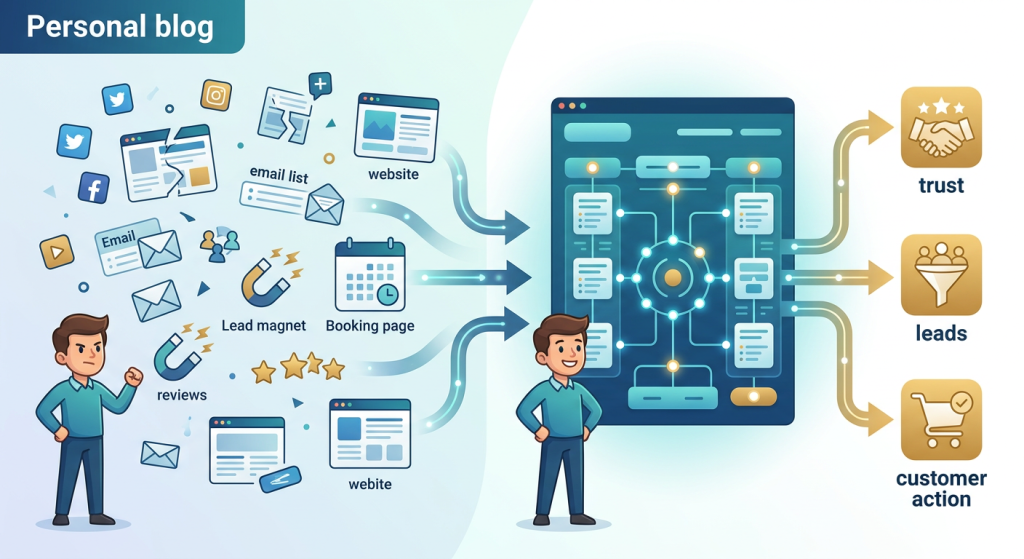
When all of those pieces are scattered, people have to work too hard to figure you out.
When they are connected, your digital identity becomes a business asset.
A Business Asset Should Create Value
A business asset is something that helps create value.
It may save time.
It may build trust.
It may generate leads.
It may support sales.
It may strengthen relationships.
It may make your business easier to understand.
Your digital identity can do all of those things.
But only if it is built with intention.
If your online presence is just a collection of random profiles, old links, outdated pages, and disconnected messages, it may still be visible — but it is not necessarily valuable.
The goal is to create a digital identity that helps people move from awareness to trust to action.
Think of Your Digital Identity as a Hub
One of the simplest ways to think about this is as a hub.
Your website or main landing page should act as the central place where people can understand who you are, what you do, and what step they should take next.
Your social platforms can then act like roads leading back to that hub.
Someone may discover you on Facebook, LinkedIn, Instagram, TikTok, YouTube, X, or another platform.
But once they are interested, there should be a clear path that brings them closer to you.
That path might lead to:
- A website
- A scorecard
- A lead magnet
- A newsletter
- A booking page
- A product page
- A contact form
- A community
- A consultation
- A service offer
The important thing is that people should not have to guess.
Make the Message Clear
Before you worry about complicated systems, start with your message.
Can people quickly understand what you do?
A clear digital identity should answer:
- Who are you?
- Who do you help?
- What problem do you solve?
- What result do you help create?
- Why should someone trust you?
- What should they do next?
If those answers are not clear, everything else becomes harder.
Your website can look nice and still fail.
Your social profile can have followers and still confuse people.
Your content can get views and still not lead anywhere useful.
Clarity comes first.
Connect the Pieces
Once your message is clear, the next step is connecting the pieces.
This does not mean every platform needs to say the exact same thing word for word.
Different platforms have different purposes.
LinkedIn may be more professional.
Facebook may be more personal.
Instagram may be more visual.
TikTok may be more casual.
Your website may be more complete.
Your email list may be more direct.
That is fine.
But the core message should be consistent.
People should be able to move from one platform to another and feel like they are dealing with the same person, same business, and same overall direction.
If your platforms feel disconnected, trust can drop.
If they feel connected, trust can grow.
Create a Clear Next Step
One of the most important parts of a strong digital identity is the call to action.
What do you want people to do next?
This is where many people lose opportunities.
They post content but do not guide people anywhere.
They build websites but do not ask people to take action.
They create profiles but do not give people a reason to click.
A good next step could be simple:
- Take a scorecard
- Book a call
- Join a list
- Download a guide
- Read an article
- Send a message
- Visit a page
- Watch a video
- View an offer
Not everyone is ready to buy right away.
That is why your digital identity should include more than one path.
Some people may want to learn more.
Some may want to contact you.
Some may want a free resource.
Some may want to follow you.
Some may be ready to work with you.
The job of your digital identity is to help each person find the right next step.
Build Trust Before the Conversation
Most people will check you out before they contact you.
They may read your website.
They may look at your social profiles.
They may scan your posts.
They may check your photos, links, reviews, testimonials, articles, or past projects.
This means trust is being built before you ever speak with them.
A strong digital identity helps you build that trust.
It shows that you are active, clear, professional, real, and organized.
That does not mean you have to look like a giant corporation.
In fact, for many small businesses and personal brands, being human and personal is a strength.
But people still need to feel confident that you are credible and that you can help.
Capture Interest Instead of Losing It
Another way your digital identity becomes a business asset is by capturing interest.
If someone visits your website or profile and leaves without doing anything, they may never come back.
That is why it is important to have a way to stay connected.
This could be:
- An email list
- A newsletter
- A free guide
- A quiz
- A scorecard
- A checklist
- A community
- A follow-up sequence
For me, this is one of the reasons a scorecard makes so much sense.
It gives people a useful starting point.
They can evaluate where they are right now, and you can continue the relationship from there.
That is much better than simply hoping they remember to come back later.
Keep It Simple at First
A lot of people delay improving their digital identity because they think it has to be complicated.
It does not.
You can start with a few simple improvements:
- Update your main bio
- Fix your important links
- Clarify your offer
- Add a clear call to action
- Make your website easier to understand
- Add a lead capture option
- Connect your main platforms
- Remove outdated information
- Make your contact process easier
Small improvements can make a big difference when they reduce confusion and make it easier for people to take action.
Your Digital Identity Should Support Your Goals
At the end of the day, your digital identity should match what you are trying to build.
If you are building a consulting business, your digital identity should help people understand your expertise and book a conversation.
If you are building a side hustle, it should help people understand the offer and take the next step.
If you are building a personal brand, it should help people understand your story, your message, and your value.
If you are building a creative project, it should help people discover, follow, support, or buy from you.
The structure may be different, but the principle is the same.
Your digital identity should move people closer to trust and action.
A Good Digital Identity Works Even When You Are Not Online
This is one of the biggest benefits.
A strong digital identity works for you even when you are not sitting at your computer.
Someone can discover you, understand you, trust you, and take a step forward without needing you to explain everything personally.
That is powerful.
It means your website, profiles, links, content, and lead capture systems are doing part of the work for you.
That is when your digital identity becomes more than an online presence.
It becomes an asset.
Start With a Simple Audit
If you want to improve your digital identity, start by taking a simple look at what already exists.
Ask yourself:
- Is my message clear?
- Is my website current?
- Are my links working?
- Do my profiles match?
- Is my offer easy to understand?
- Is there a clear next step?
- Am I capturing leads?
- Do I look trustworthy online?
- Does my digital presence support my current goals?
If you are not sure where to begin, that is why I created the Web Money Leak Scorecard.
It is designed to help entrepreneurs, freelancers, creators, consultants, side hustlers, and small business owners identify the gaps in their online presence and see where their digital identity can become stronger.
Your online presence may already exist. Now the goal is to make it work.